Best High-End Speaker Brands Ranked by Experts
Two pairs of towers stand a few feet apart on a dealer floor. Both are three-way designs, both list a frequency response that reads nearly identically on paper, and one costs three times what the other does. The forum threads read the night before contradicted each other on every point. Then a familiar recording goes on, a voice you have heard a thousand times arrives from between the speakers with the body and breath of a person standing there, and the sheet of specifications suddenly explains none of it. That gap between measured numbers and what your ears report is the whole difficulty of shopping for high end speakers.
Hear the Best Speakers in the Midwest Before You Buy Them
Flanner’s Home Entertainment has been Milwaukee’s high-end audio destination for decades, with dedicated listening rooms where serious speakers can be compared side by side on properly matched electronics. Our team helps you match speakers to your room, your amplifier, and the music you actually play.
The encouraging reality is that expert reviewers and custom integrators are not guessing either. They rank brands against a consistent set of criteria that anyone can learn, apply, and use to cut through marketing copy. At Flanner’s Home Entertainment, our audio specialists spend their days matching high end speakers to Milwaukee area rooms and systems, and our dedicated listening rooms exist so those comparisons happen with your ears rather than a spec sheet. This guide covers what actually separates a high end speaker from a mainstream one, the criteria experts use to rank brands, how brand house sound works, matching speakers to your room and amplifier, where diminishing returns begin, how to audition properly, and the ranked lineup you can hear in our showroom.
Key Takeaways
• Engineering, not price, defines the category: Driver materials, cabinet bracing, crossover quality, and manufacturing consistency are what put a loudspeaker in the high end tier, and each one connects to something you can hear.
• Experts rank brands, not single models: A flagship review says little about the brand’s whole catalog, so consistency across price tiers is what separates a great brand from a great product.
• House sound is real and personal: Manufacturers voice their lineups deliberately, and the right choice depends on your library and your room rather than on which tuning is objectively correct.
• The system decides how much you hear: Amplifier matching, room acoustics, and placement determine whether high end speakers deliver their capability or merely hint at it.
What Actually Separates High End Speakers From Mainstream Models
Price alone does not define the category. What separates high end speakers from mainstream models is the amount of engineering effort spent on problems that are expensive to solve and easy to ignore, and every one of those choices maps to something audible.
Start with the drivers. Tweeter material determines how a speaker behaves at the top of its range, and the high end tier reaches for beryllium, diamond, and heavily treated soft domes because each pushes the material’s breakup mode above the audible band. When a dome flexes instead of moving as a rigid piston, you hear it as hardness and glare on massed strings and cymbals. Midrange and woofer cones face the same problem lower down, which is why composite, woven, and ceramic-coated cones show up at this level. Behind the cone, motor and magnet design controls how linearly the driver moves, and linear motion is what keeps a complex passage from turning to mush.
Cabinets Are Not Just Boxes
An enclosure that resonates adds its own sound to everything you play, and that coloration is one of the primary limits on clarity in affordable speakers. Serious cabinets use internal bracing tied between panels, constrained-layer damping, thick front baffles, and rounded or chamfered edges that reduce diffraction, which is the smearing that happens when sound waves wrap around a sharp cabinet edge and arrive at your ears slightly late.
Crossovers and Measured Behavior
The crossover divides the signal between drivers, and its quality shows up as driver integration. Tight part tolerances, phase coherence between sections, and careful attention to how drivers hand off determine whether a three-way speaker sounds like one voice or three.
A few measurements matter more than the rest, translated into plain terms:
• Frequency response linearity: How evenly the speaker reproduces the whole range, which you perceive as tonal accuracy rather than a boosted or scooped character.
• Off-axis behavior and dispersion: How the sound changes as you move off center, which determines how large the sweet spot is and how much of what you hear is room reflection.
• Sensitivity: How much output the speaker produces for a given amount of power, which decides how much amplifier you need.
• Impedance curve: The electrical load the speaker presents, where deep dips demand an amplifier with real current delivery.
Manufacturing consistency is the differentiator nobody advertises. Hand assembly, matched driver pairs measured against a reference, and parts support that still exists fifteen years later are the difference between a speaker you own and a speaker you eventually replace.
Read More: Top-Rated Bookshelf Speakers for Living Rooms, Offices, and Bedrooms | Powered Bookshelf Speakers for Music Lovers & Home Studios
How Experts Rank High End Speaker Brands
Ranking a brand is a different exercise from reviewing a model, and the distinction matters because most buyers will not purchase the flagship. Reviewers, integrators, and industry judges apply a consistent framework:
• Sonic performance and neutrality: How accurately the lineup reproduces recordings across genres, judged against live reference points rather than personal taste alone.
• Consistency across the full price range: Whether the entry model shares the engineering DNA of the flagship, which is the strongest indicator of a serious brand.
• Research and proprietary technology: Whether the company develops its own drivers, cabinets, and crossover approaches or assembles parts from catalog suppliers.
• Build quality and finish craftsmanship: Veneer matching, joint work, hardware quality, and the standard of finish under normal room lighting.
• Value against direct competitors: What the speaker delivers compared with everything else at that price, not compared with everything else in the store.
• Dealer network and service support: Whether trained dealers exist, whether parts are stocked, and whether a driver can be replaced ten years from now.
• Reliability and resale strength: Long-term durability and how well the brand holds value on the secondary market.
Critical listening evaluations follow a discipline. Levels are matched precisely between comparisons, because a difference of even a decibel makes the louder option sound better. Familiar reference recordings are used instead of demo tracks chosen to flatter equipment. Comparisons are run blind or semi-blind wherever the setting allows, since knowing which speaker is playing shapes what you think you hear.
Specifications have real limits. Two speakers with similar published frequency response can sound entirely different because published curves rarely show off-axis behavior, distortion under load, or how the cabinet behaves under real output. The concept experienced listeners use instead is house sound, the tonal signature a manufacturer builds into everything it makes.
Brand House Sound: Why High End Speakers Have Distinct Personalities
House sound is not an accident or a defect. It is a set of deliberate voicing decisions a company makes and repeats across its lineup, and it is why loyal owners recognize a brand within a few bars.
The tuning philosophies you will encounter come down to a handful of approaches:
• Neutral and analytical: Flat response and high resolution, so recordings arrive with minimal editorializing. Ideal for well-recorded acoustic material and for anyone who wants to hear the mix rather than an interpretation of it.
• Warm and forgiving: A gently relaxed top end and a full lower midrange, which makes long sessions comfortable and treats imperfect recordings kindly.
• Dynamic and high sensitivity: Horn-loaded and high-efficiency designs that produce large output from modest power and reproduce sudden dynamic swings with impact. A natural fit for movies, live recordings, and rock.
• Richly voiced for tonal beauty: Tuning that prioritizes the weight and body of voices and orchestral instruments over maximum detail retrieval.
Recording quality interacts with all of this. A highly revealing speaker will expose the compression and limiting baked into a lot of streaming material, which some listeners find honest and others find tiring. If most of your listening is compressed streaming in the background while you cook, a forgiving tuning will serve you better than an analytical one no matter what the reviews say.
A Quick Self-Assessment
Before you shop, answer four questions honestly:
• What does the majority of your listening actually consist of, by hours rather than by aspiration?
• How long do your typical sessions run, since fatigue only shows up after an hour?
• How good are your sources, meaning high resolution files and well-mastered vinyl versus compressed streams?
• Is the system primarily for music, primarily for movies, or genuinely both?
Room acoustics shift all of it. A bright room with plaster walls and bare floors will make a neutral speaker sound analytical and an analytical speaker sound harsh, which is exactly why house sound cannot be judged from a review written in someone else’s room.
Read More: 5 Reasons Customers Choose McIntosh Speakers | Choosing the Right In-Wall Speakers for Your AV Setup
Matching High End Speakers to Your Room, Amplifier, and System
Speakers of this caliber are only as good as the system and the room around them. That is not a sales line, it is the most common reason an expensive pair disappoints its owner.
Amplifier matching comes first. Sensitivity tells you how loud a speaker plays per watt, and nominal impedance with its minimum dip tells you how hard the load is to drive. A speaker with low sensitivity and an impedance that drops into the low single digits needs an amplifier with real current delivery, not just a high wattage number on the box. Underpowered, such a speaker sounds compressed and flat exactly when the music gets demanding, which owners often misdiagnose as a speaker problem.
Room size and speaker scale need to agree. A large tower in a small room overloads it with bass energy the room cannot absorb, producing boom rather than authority. A small stand-mount monitor in a large open room simply runs out of output and depth. Matching scale to volume is more important than moving up a model tier.
Placement and Boundary Reinforcement
• Pull speakers out from the front wall until bass tightens and the soundstage gains depth, usually a foot or more.
• Keep side wall distance different from front wall distance so both boundaries do not reinforce the same frequencies.
• Set up an equilateral triangle between the speakers and your seat, then adjust toe-in a few degrees at a time.
• Expect corner placement to add bass output while reducing bass accuracy, which is a trade rather than a free gain.
Source quality deserves an honest read. Digital to analog conversion, streaming resolution, and turntable setup all matter, but their contribution is smaller than the room’s, and a well-set-up turntable with a properly aligned cartridge does more for vinyl playback than most electronics upgrades. Speaker cable and interconnects should be chosen for adequate gauge, appropriate length, and secure termination. Beyond that, the returns are small compared with moving a speaker six inches.
If the system serves both music and movies, look for a brand offering voice-matched center, surround, and architectural models. Timbre matching across channels is what makes a sound move across the front stage without changing character, and it is far easier to achieve within one brand’s lineup.
A Sensible Budget Allocation
Most brand roundups skip this entirely. As a starting framework for a serious two channel system, plan on roughly half the budget for speakers, a quarter for amplification, and the remaining quarter split between sources, room treatment, and professional installation. Shift more toward the room in a difficult space and more toward amplification if the speakers you love are power hungry.
What You Gain and Where Diminishing Returns Begin
The step from good mainstream speakers into entry level high end is the largest audible jump most people will ever hear. Cabinets stop contributing their own coloration, dynamic swings arrive intact instead of compressed, and the soundstage develops depth so instruments occupy positions rather than blending into a flat wall.
The step from entry high end into flagship territory is real but smaller and more specific. What improves is bass control at the very bottom, resolution of low-level detail such as room tone and decay, dynamic capability at high volume, and cabinet and finish quality that belongs in a living room. What does not improve proportionally is basic tonal accuracy, which good engineering achieves well below the top of the market.
Diminishing returns arrive earlier than the industry likes to admit. Past a certain point, room treatment, better placement, and properly matched amplification deliver more audible improvement per dollar than another speaker upgrade, because they address problems the new speakers would inherit anyway.
Strong brands hold value, which changes the math. Demo units and trade-in programs let buyers step up gradually, and speakers with available parts and service can be refoamed, re-capped, and refinished decades into ownership. A quality pair is a fifteen to thirty year purchase, not a five year one.
The honest test for whether to upgrade or optimize: if you have not treated the first reflection points, moved the speakers off the wall, and confirmed your amplifier can drive them, optimize first. If all three are done and you still want more, upgrade.
How to Audition High End Speakers the Right Way
An audition is an experiment, and most auditions are run badly. Here is a repeatable method that produces a decision you will still agree with a year later.
Bring your own recordings, several of them, across genres and formats. Familiarity matters far more than audiophile pedigree, because you cannot evaluate accuracy against a track you have never heard. Include a solo voice, a small acoustic ensemble, something dense and loud, and something you know is poorly recorded.
Insist on level matching between comparisons. In a quick back-and-forth the louder speaker wins nearly every time, regardless of quality, and a difference of one decibel is enough to skew the result.
What to Listen For
• Vocal naturalness: Does a familiar voice sound like a person in the room or like a recording of one?
• Instrument timbre: Does a piano sound like wood and steel, and does a cello have body below the bowing sound?
• Soundstage and imaging: Do instruments occupy distinct positions with space between them, and does the stage extend behind the speakers?
• Bass definition versus bloat: Can you follow a bass line note by note, or does it become a general warmth?
• Dynamic swing: Does a sudden loud passage arrive with force, or does it flatten out?
• Fatigue: After forty minutes, do you want to keep listening or turn it down?
Mistakes That Make Auditions Misleading
• Comparing for five minutes when fatigue and long-term satisfaction only reveal themselves over a longer session
• Auditioning in a room dramatically different in size from your own, which changes bass response entirely
• Listening at a volume much higher than you play at home, since perceived tonal balance shifts with level
• Judging with unfamiliar demo tracks selected because they flatter equipment
• Failing to ask what electronics are driving the speakers, which can account for much of what you hear
• Skipping the questions that matter after the sale, including in-home demonstration, trade-in policy, and whether setup and calibration are included
Read More: Surround Sound 101: What You Need to Know | What Is a Powered Subwoofer & Do You Need One?
High End Speaker Categories and Brand Tiers Compared
Use this table to narrow the format before you narrow the brand, since format decides more about your result than the badge does. Read across the row that matches your room and your intended use.
| Speaker Format | Room Size Suited | Bass Extension | Amplifier Demand | Placement Flexibility | Best Use |
|---|---|---|---|---|---|
| Floorstanding towers | Medium to large | Deep, often full range | High, wants current | Needs space off walls | Two channel music and large theaters |
| Stand-mount monitors | Small to medium | Limited, wants a subwoofer | Moderate to high | Flexible on stands | Near-field music and small rooms |
| Center channels | Any theater room | Midrange focused | Moderate | Must sit near the screen | Movie dialogue clarity |
| In-wall and in-ceiling | Any, planned in advance | Varies by model and cavity | Moderate | Fixed at install | Whole-home audio and height channels |
| On-wall designs | Small to medium | Modest | Low to moderate | Mounts flat to the wall | Rooms with no floor space |
| Subwoofers | Any | The deepest available | Self-powered | Position is critical | Bass support for every format above |
The pattern in that table is a trade between bass capability and placement freedom, and the honest answer for most rooms is a smaller speaker plus a properly placed subwoofer rather than the largest tower that fits.
Brand tiers work the same way. Accessible high end buys you real engineering, a neutral voice, and a cabinet that stays out of the way. True high end adds proprietary driver technology, deeper bass control, and finish quality you notice from across the room. Statement and flagship level buys the last increments of dynamic capability and resolution, plus cabinetry built like furniture, and it is the tier where returns narrow fastest.
High End Speakers Pros and Cons Serious Listeners Should Weigh
A serious pair of speakers is one of the few purchases in consumer electronics that can still be delivering its best performance twenty years from now. That longevity is real, and so are the commitments that come with it. Both sides deserve a clear look before you commit a budget.
Pros
Resolution and dynamic realism:
Low-level detail and sudden dynamic swings survive intact, which is what makes a recording feel like an event rather than background.
Long service life:
Quality drivers, cabinets, and crossovers are built to last decades, and refoaming or parts replacement is realistic on brands with genuine support.
Strong resale value:
Respected brands hold value well, so stepping up later costs less than the sticker difference suggests.
Finish and cabinetry quality:
Veneer work, joinery, and hardware at this level belong in a room people actually live in.
Dealer and service backing:
Buying through a specialty dealer brings setup guidance, system matching, and someone local to call years later.
Cons
Higher cost of entry:
The engineering that produces these results is expensive to design and build, and the price reflects it.
Dependency on the rest of the system:
Matched amplification and reasonable room acoustics are requirements rather than refinements, and skipping them wastes much of what you paid for.
Physical size and placement demands:
Larger cabinets need space off the walls, which competes directly with how most living rooms are arranged.
What Milwaukee Homes Do to High End Speakers
Wisconsin is a harder environment for fine loudspeakers than most buying guides account for, and the reasons are specific to how houses here are built and heated. Milwaukee’s older bungalows, duplexes, and near-north side homes are finished in plaster over lath rather than drywall, and plaster is denser and more reflective at high frequencies. In practice that means a speaker described as neutral in a review sounds noticeably brighter in a Bay View parlor than it did in the reviewer’s treated room, which is why our listening rooms matter more here than they would in a market full of new construction. Then there is the heating season. From November through March, forced air and radiator heat pull indoor relative humidity down into the teens and twenties, and the wood veneers, cabinet joints, and driver surrounds in a fine speaker were engineered for something closer to normal room conditions.
What that means for anyone buying serious speakers in southeastern Wisconsin:
• Favor a slightly warmer house sound if your listening room has plaster walls, tall uncovered windows, and hardwood floors, since the room will add brightness you cannot remove.
• Keep cabinets away from radiators, baseboard heat, and forced air registers, where the local temperature swing is far larger than the room average.
• Watch humidity through the heating season, because dry winter air is harder on wood cabinets and surrounds than any single day of summer humidity off the lake.
• Plan basement listening rooms around a concrete floor and low ceiling, which is a bright, mode-heavy combination that rewards a rug and corner treatment before it rewards a speaker upgrade.
• Account for the lake effect on the other side of the year, since humid August air in an unconditioned upper flat is its own stress on cabinets and cones.
• Give speakers a day to reach room temperature after a winter delivery before serious listening, since cold suspension parts do not measure or sound the way they will once settled.
Here is the maintenance detail our team walks through with every high end speaker customer in this climate: run a humidifier through the heating season and keep the listening room between roughly 35 and 50 percent relative humidity. That single habit protects veneer seams, cabinet joints, and driver surrounds better than anything else you can do, and it costs less than one interconnect.
The Best High End Speaker Brands and Models Ranked at Flanner’s
A note before the lineup, because honesty is worth more than a tidy list. The systems below are the Sony BRAVIA Theater components currently available on our site, ranked by capability using the criteria established earlier in this article, and they represent Sony’s serious home theater engineering rather than the full range of audiophile tower brands we carry. If you finished the sections above wanting floorstanding towers, stand-mount monitors, or architectural speakers from the high end brands we stock, our listening rooms are where those comparisons happen, and our team will set up a private session. What follows is ranked from the most capable system down.
Sony® BRAVIA Theater 4.0.4 Channel Home Theater System

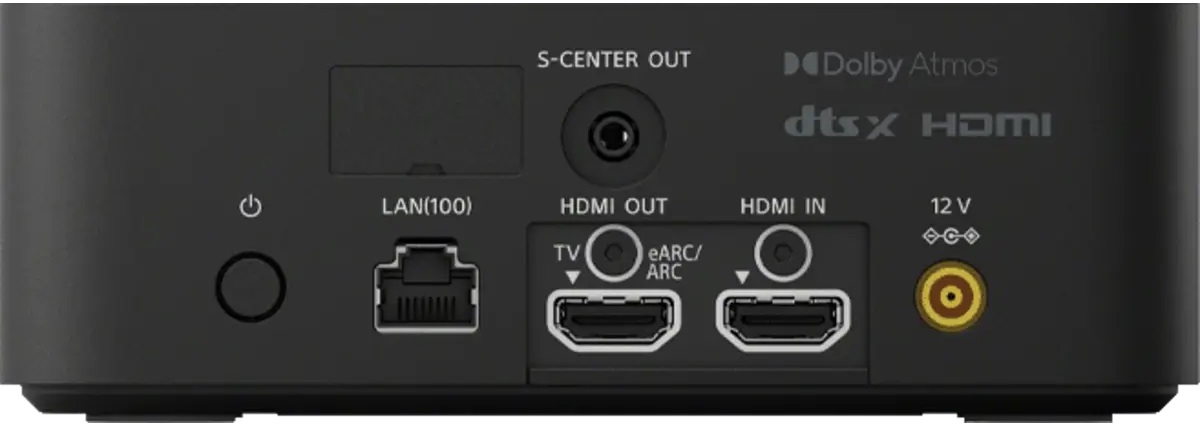
This earns the top position because it is the only entry here that delivers a complete multichannel front and height stage as a designed system rather than a bar plus additions. The 4.0.4 configuration means four main channels and four dedicated height channels, which is a genuine overhead layer rather than a simulated one. Sony’s house character runs neutral with strong dynamic control, so it handles both film soundtracks and music without exaggerating either. It suits a listener who wants immersive audio in a room where running speaker wire is not practical, and it scales with a matched subwoofer.
Top Features
• 4.0.4 channel configuration: Four height channels give overhead effects real separation instead of processed simulation.
• Complete system design: The channels are voiced and matched to each other, which is the timbre consistency covered earlier in this guide.
• Wire-free multichannel: Full surround capability without opening plaster walls in an older home.
• Expandable with a matched subwoofer: Bass support can be added and positioned independently for even response.
Sony® 3.1 Channel Soundbar
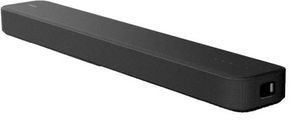
Second place goes to the most complete single-bar performer in this group. The 3.1 configuration gives dialogue its own dedicated center channel, which is the difference between following a conversation and reaching for the remote, and the subwoofer channel supplies the low end no flat panel can produce. Judged against the consistency criterion from earlier, this is where Sony’s engineering shows up at a sensible price. It fits a main living room or a den, and it becomes the front stage of a larger system when wireless rears and a subwoofer are added later.
Top Features
• Dedicated center channel: Voices stay anchored and intelligible rather than blended into a stereo mix.
• Integrated subwoofer channel: Real bass extension without adding a component decision on day one.
• Foundation for expansion: Works as the front stage when wireless rear speakers and subwoofers are added.
• Compact placement: One bar under the display removes most of the placement variables larger systems introduce.
Sony® Black Wireless Subwoofer

The SA-SW5 is the larger of the two wireless subwoofers Sony offers for these systems, and it ranks this high because bass capability is the most common limitation in a soundbar-based setup. Adding real low frequency output changes how a system handles film effects and music alike, and because it connects wirelessly, you can place it where the room sounds best rather than where the cable reaches. That freedom is the entire point, given how much subwoofer position determines bass quality. It suits larger rooms and open floor plans where a compact sub runs out of authority.
Top Features
• Larger of the two wireless subwoofers: More output and deeper extension for bigger rooms.
• Wireless connection: Placement is decided by acoustics rather than by cable routing.
• Matched to Sony systems: Integrates with the BRAVIA Theater soundbars and systems as a designed partner.
• Addresses the biggest soundbar limit: Low frequency capability is where compact systems most often fall short.
Sony® Black Wireless Rear Speakers
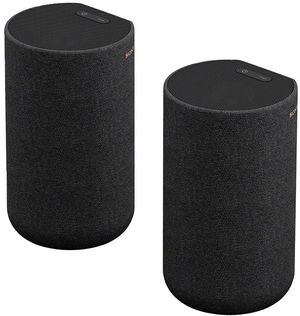
The SA-RS5 pair is the step-up rear speaker option, and rears are the single upgrade that turns a front-facing soundbar into an actual surround system. Effects that previously stayed pinned to the screen begin traveling around and behind the listening position, which is the envelopment the placement section described. Because they are wireless, they solve the hardest installation problem in older Milwaukee homes, which is getting speaker wire to the back of a finished room. They suit anyone whose system already sounds good in front and flat behind.
Top Features
• Step-up rear speaker pair: The more capable of Sony’s two wireless rear options.
• True surround envelopment: Effects move behind the seats instead of staying at the screen.
• No wire through finished walls: The practical answer for plaster-and-lath homes and finished basements.
• Designed system integration: Levels and voicing are handled by the host system rather than set by guesswork.
Sony® Black Wireless Subwoofer
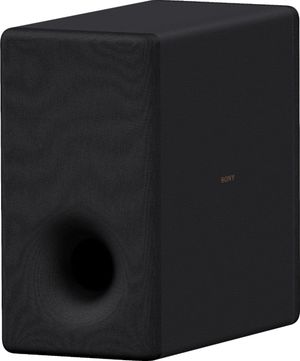
The SA-SW3 is the compact wireless subwoofer in the pair, and it earns its place for rooms where the larger model would be more than the space can absorb. A smaller sealed room, an apartment, or a condo with shared walls does not need maximum output, it needs even, controlled bass that does not overload the room or annoy the neighbors. That is a real engineering match rather than a compromise. Place it using the crawl method and a compact subwoofer in the right spot will outperform a large one in the wrong spot every time.
Top Features
• Compact cabinet: Sized for smaller rooms, apartments, and condos where a large sub overloads the space.
• Wireless placement freedom: Position by ear rather than by outlet and cable length.
• Matched to Sony soundbars: Connects as a designed partner rather than a generic add-on.
• Right-sized bass: Even response in a small room beats raw output that the room cannot control.
Sony® Black Wireless Rear Speakers
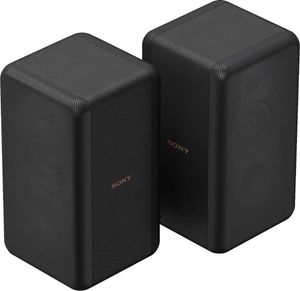
The SA-RS3S pair is the more accessible route to rear channels, and for many rooms it is all the rear speaker anyone needs. Rear channels carry ambience and effects rather than the heavy lifting of dialogue and music, so a compact pair positioned correctly delivers most of the surround benefit at a friendlier price. They fit a medium living room, a bedroom system, or a first expansion for someone who bought a soundbar and wants the rest of the experience. Mount them slightly above ear height and angle them toward the seats.
Top Features
• Accessible rear channel option: The practical entry point into real surround for an existing soundbar.
• Compact and easy to place: Small cabinets fit on shelves, stands, or wall mounts behind the seating.
• Wireless operation: No wire runs through walls, floors, or under rugs.
• Meaningful upgrade per dollar: Adding rears changes the experience more than most component swaps at this price.
Sony® 2.1 Ch Black Soundbar
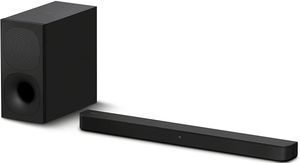
Last in the ranking and honest about why. The HT-S400 is a two channel bar with a subwoofer channel, which means wider stereo separation and genuine bass compared with a television’s built-in drivers, but no dedicated center channel doing the work of dialogue clarity. Judged by the criteria in this article, it belongs in a second room rather than a main system. For a kitchen, a bedroom, a home office, or a cottage up north, it is an easy and effective improvement that installs in about ten minutes.
Top Features
• Two channels plus a subwoofer: Real bass and wider sound than any flat panel produces on its own.
• Simple installation: One connection to the television and a wireless subwoofer.
• Secondary room fit: Well matched to kitchens, bedrooms, offices, and vacation properties.
• Clear position in the lineup: The honest entry point rather than a main-system contender.
Choosing Among the Best High End Speakers Starts With a Listen
Brand rankings come from consistent engineering and quality across a full lineup rather than from one impressive flagship, house sound should match your library and your room rather than someone else’s taste, and system and room matching decide how much of that capability you actually hear. No specification sheet, and no article including this one, can substitute for forty minutes with your own recordings.
That is what our listening rooms are for. Flanner’s Home Entertainment maintains dedicated high-end listening rooms where speakers can be compared side by side at matched levels on properly chosen electronics, staffed by people who know these brands deeply and can talk through amplifier matching, room acoustics, and where your budget stops buying improvement. Our custom AV team handles system design, professional installation including in-wall and in-ceiling work, calibration with real measurement tools, and local service years after the sale. Speakers at this level judged from photographs and specifications alone are a gamble no online retailer can remove. Schedule a private listening session or visit the showroom and hear the difference for yourself.
Frequently Asked Questions About High End Speakers
A high end speaker is defined by engineering rather than price, specifically advanced driver materials such as beryllium or diamond tweeters, heavily braced and damped cabinets that do not add resonance, precision crossovers with tight part tolerances, and manufacturing consistency including matched driver pairs. Those choices are expensive because each one addresses a specific audible problem, and together they produce the low distortion, linear response, and controlled dispersion that separate the category from mainstream models.
Experts rank brands on sonic neutrality, consistency across the entire price range, proprietary engineering, build quality, value against direct competitors, dealer and service support, and long-term reliability, and the brands that place highest score well on all seven rather than excelling at one. Because rankings shift with each product generation, the more useful approach is applying those criteria yourself and auditioning the finalists side by side in a proper listening room.
A workable starting framework puts roughly half of a two channel budget into speakers and about a quarter into amplification, with the remainder split among sources, room treatment, and installation. That ratio shifts toward amplification when the speakers have low sensitivity or a demanding impedance curve, since a speaker starved of current sounds compressed no matter how good it is.
Neither is better in the abstract, because the right answer depends on room size and placement freedom. Towers deliver deeper bass extension and greater output for medium and large rooms, while stand-mount monitors often image more precisely, fit smaller rooms without overloading them, and pair extremely well with a properly placed subwoofer that outperforms a tower’s in-cabinet bass in most real rooms.
A dedicated room is not required, but some acoustic attention is, because room reflections and room modes shape what you hear as much as the speakers do. An area rug, lined drapes, absorption at the first reflection points, and corner bass trapping deliver a large share of the benefit in a normal living room, and in a difficult space that treatment improves the result more than upgrading the speakers would.
The largest audible gain comes from stepping out of mainstream speakers into entry level high end, where cabinet coloration drops away and dynamics and soundstage depth arrive. Above that point improvements are real but narrower, concentrated in deep bass control, low-level resolution, and finish quality, and once your amplification, placement, and room are sorted, further spending on speakers returns less than fixing whichever of those three is weakest.
Why Trust Flanner's Home Entertainment?
When you choose Flanner’s Home Entertainment, you're trusting a deeply rooted, family-owned legacy that dates back to 1891 a company that has evolved from a piano and sheet-music shop into a premier specialty retailer of high-end audio, video, and smart-home systems. With showrooms in West Allis and Northshore Grafton, Flanner’s combines decades of expertise and personalized service. Its team includes members with 15–30 years of industry experience to design and install tailored home theater, multi-room audio, networking, and control solutions. Over its more than 130-year history, the business has maintained its commitment to craftsmanship, reliability, and genuine customer relationships, making every system feel as thoughtfully built as the business itself.