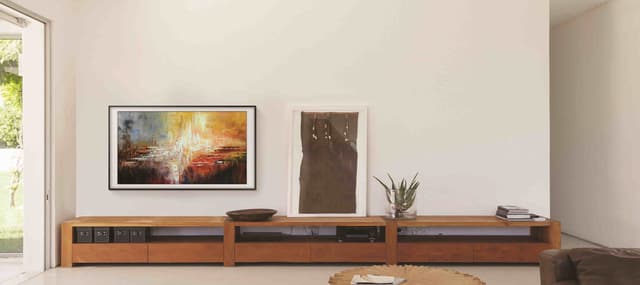
The accent wall took two coats and a full Saturday, the sectional finally sits where it belongs, and every corner of the room reads the way it was planned. Every corner except the one above the console. A big black rectangle hangs there staring back at the sofa all evening, with a power cord and an HDMI cable running down the drywall to a media cabinet nobody wants to look at. Guests walk in and their eyes land on it first. That dead panel is exactly why a Frame TV keeps showing up in design photos, remodel plans, and showroom questions.
See a Frame TV on the Wall Before You Buy One
Our team keeps The Frame and Frame Pro on display so you can judge the matte screen and bezel finishes against real furniture. Shop art-mode TVs, mounts, and professional installation in one place.
That gap between decor and technology already has a fix, and it has been sitting on showroom walls for years. At Flanner’s Home Entertainment & Appliance, we display these sets, mount them, hide the wiring inside the wall, and set up the artwork before we leave. This guide covers what a Frame TV actually is, how the matte display and Art Mode work together, how installation makes every cable disappear, the honest picture quality trade-offs, and how to pick the right size for the wall you have.
Key Takeaways
• Art first, television second: A Frame TV is a 4K panel with a matte anti-glare screen, a swappable bezel, and an Art Mode that shows artwork or photos whenever nobody is watching.
• Sensors run the illusion: A motion sensor wakes the panel when someone enters and shuts it down when the room empties, while a brightness and color sensor keeps the artwork from glowing at night.
• One cable, no gap: The One Connect design moves inputs and power away from the screen so a single slim cable reaches the panel, which is what makes flush mounting look like a picture frame.
• The trade is design for raw output: At the same price, a conventional set usually delivers deeper contrast and more peak brightness, which is why the Frame Pro tier exists.
What Is a Frame TV? The Art-Panel Television Explained
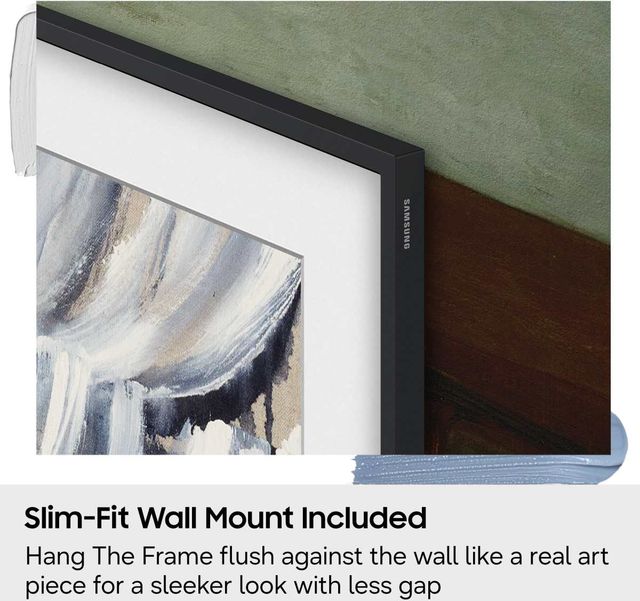
A Frame TV is a flat-panel 4K television engineered to look like a framed picture on the wall. It combines a matte anti-glare screen, a swappable magnetic bezel, a slim flush mount with almost no wall gap, and an Art Mode that displays artwork or personal photos whenever the set is not being watched.
You will see the category called several things while shopping. Art TV, lifestyle TV, and picture frame TV all point at the same idea. Samsung The Frame is the model line that created the category and still defines it, though other brands now offer their own art-mode features.
Two families carry the line today. The standard Frame covers most rooms and most budgets. The Frame Pro sits above it with brighter backlighting and stronger processing for people who want the art look without giving up much performance. Between the tiers, sizes run from roughly 43 inches up to 98 inches.
Here is the part most articles skip. This television is not for every wall in the house. It earns its price in rooms where the screen is a focal point you look at all day whether it is on or off.
• Great rooms and open-concept living spaces where the TV wall faces the kitchen and dining area
• Bedrooms, where a dark rectangle above the dresser fights everything else in the room
• Dining rooms, home offices, and hallways that were never meant to hold electronics
• Above-fireplace placements, where the screen sits at eye level for anyone standing
The defining traits are consistent across sizes:
• Matte anti-glare screen finish with a canvas-like texture
• Art Mode with a rotating gallery of artwork and personal photos
• Motion and ambient light sensors that manage when and how bright the art appears
• Magnetic bezels sold separately in finishes like white, walnut brown, teak, and black
• A slim wall mount that holds the panel nearly flat against the wall
• One Connect cable routing that reduces the wall run to a single thin cable
Read more:
Sony vs Samsung TVs: Which Is Better?
Top Places to Install a Mirror TV
How Does a Frame TV Work? Matte Display, Sensors, and Art Mode
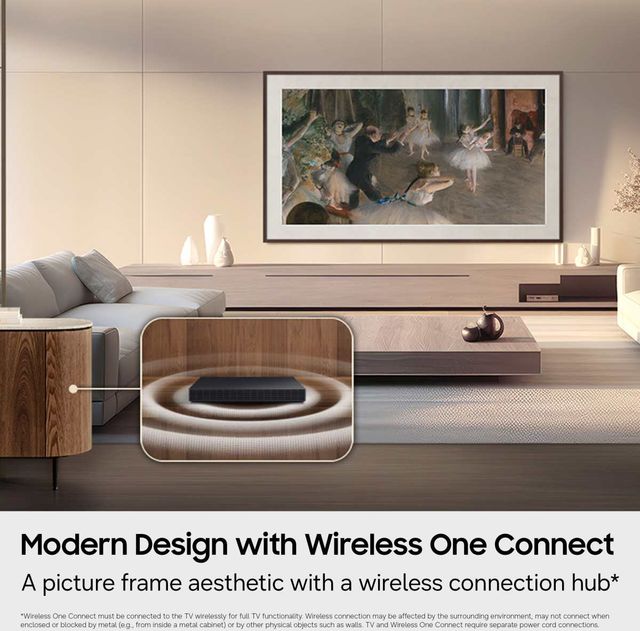
Four systems work together to sell the illusion. Take any one of them away and the wall goes back to looking like it has a TV on it.
The Matte Anti-Glare Screen
Standard TV panels use a glossy finish that acts like a mirror. Point one at a west-facing window in a Wisconsin living room and by late afternoon you are watching the window instead of the show. The matte coating on a Frame TV scatters that light across the surface instead of bouncing it straight back.
The texture matters as much as the reflection control. Under the coating, artwork picks up a faint canvas grain rather than looking like a photo trapped behind glass. That is the single biggest reason people walk past one in a showroom and ask where the painting came from.
There is a cost, and it is worth knowing up front. Diffusing light also lifts black levels slightly in a dark room and takes some of the sparkle out of specular highlights, like sunlight glinting off water.
The Motion and Brightness Sensors
Two sensors handle the behavior that surprises new owners most.
The motion sensor watches for people. Walk into the room and the panel wakes into Art Mode on its own. Leave, and after a set delay the screen powers down instead of burning electricity on an empty room.
The second sensor reads ambient light and color temperature. It dims the artwork as the room gets darker and shifts the color balance to match your lamps and daylight. That is why a properly set up Frame TV does not glow like a light box at nine o’clock at night.
The Art Mode Software Layer
Art Mode is the part that makes it art. It sizes the image to the panel, applies an optional digital mat and border, and rotates through a playlist on a schedule you choose. It also holds brightness far below normal video levels, which is what keeps the image looking like a print instead of a screen.
The One Connect Design
Every input and the power supply for the box live in a separate One Connect unit that sits in a cabinet, a closet, or a recessed enclosure in the wall. Your cable box, game console, and streaming stick all plug in there. Only one slim cable travels to the television itself.
That single cable is the whole reason flush mounting works. A conventional set needs a power cord plus HDMI runs at the panel, which forces either a bulge behind the TV or a bundle of wires down the wall. On the Pro tier, that connection moves to a wireless link, leaving power as the only thing to hide.
Energy use comes up constantly, and the answer is reassuring. Art Mode runs the panel at a fraction of full video brightness, so displaying artwork all evening costs far less than watching a movie at peak output. Between motion shutoff and scheduled timers, most households never leave it running to an empty room anyway.
Here is what actually happens the moment the last person walks out:
1. The motion sensor registers that the room is empty and starts its countdown.
2. If nobody returns within the delay window, the panel drops out of Art Mode.
3. The screen powers down to a low-draw standby state.
4. When someone walks back in, motion detection wakes the panel into Art Mode.
5. The light sensor reads the room and sets artwork brightness and color to match.
Art Mode and the Samsung Art Store: What You Can Actually Display

Three sources feed the screen, and understanding them prevents the most common misconception about this category.
The first source is the complimentary artwork built into the set. Every Frame TV ships with curated pieces and free rotating collections you can display forever without paying anything extra. No subscription is required to use Art Mode.
The second source is the paid art library, a subscription catalog of thousands of licensed museum and gallery works. It is optional. It exists for people who want a deep, constantly refreshed rotation rather than a fixed set of images.
The third source is your own photo library, uploaded from a phone app or a USB drive. This is where most families end up spending their time.
Getting Personal Photos to Look Like Real Prints
A phone snapshot dropped straight onto a large panel usually looks like a phone snapshot. A little preparation changes that completely.
• Use horizontal images at the highest resolution you have, since the panel is a wide 16 by 9 shape and vertical phone photos get cropped hard or pillared with mats.
• Crop deliberately rather than letting the software decide, especially with faces near the edge of the frame.
• Apply a mat layout to portrait images so they read as a matted print instead of a stretched photo.
• Match mat color to the wall or the trim rather than to the photo, which is the trick that makes it look framed.
• Build a rotation with a slow interval, since art that changes every two minutes reads as a screensaver.
Budget-minded options are worth knowing about too. Public-domain archives from major museums put thousands of high-resolution scans online at no cost, and independent digital art shops sell single pieces or bundles sized specifically for these panels. Downloaded files load the same way personal photos do.
One styling note that pays off in a Midwest home. Large-scale abstracts and photography suit modern and transitional interiors, while botanical prints, scenic oil paintings, and classical works sit more naturally in traditional rooms with wood trim and heavier furniture.
Frame TV vs Regular TV vs Frame Pro: A Side-by-Side Comparison
Three columns, one honest look at where each type of television actually wins.
| Feature | Frame TV | Frame Pro Tier | Conventional 4K TV |
|---|---|---|---|
| Screen finish and glare handling | Matte anti-glare, canvas texture | Matte anti-glare with brighter panel behind it | Usually glossy, mirrors windows and lamps |
| Peak brightness and contrast | Good, slightly softened blacks | Stronger contrast and higher output | Highest output per dollar |
| Backlight technology | QLED backlight | Neo QLED mini-LED backlight | Ranges from LED to OLED |
| Art Mode and art library access | Included artwork plus optional subscription | Included artwork plus optional subscription | Not available |
| Bezel customization | Magnetic bezels sold separately | Magnetic bezels sold separately | Fixed bezel only |
| Cable routing and wall gap | One Connect single cable, near-flush mount | Wireless connection, power only at the wall | Power plus HDMI at the panel, visible gap |
| Refresh rate and gaming | High refresh with low input lag modes | High refresh with the extra brightness for HDR games | Varies widely by model and price |
| Typical size range | Roughly 43 to 85 inches | Roughly 65 to 98 inches | Roughly 32 to 98 inches |
| Price position at the same size | Premium over a comparable conventional set | Highest of the three | Best raw performance per dollar |
Read the columns by room, not by spec count. The standard Frame suits decor-driven living spaces where the wall is on display all day and the TV is on for a few hours of it. The Frame Pro belongs in bright rooms and serious viewing spaces that need extra punch behind the matte finish. A conventional set is still the right answer for a dedicated basement theater where nobody sees the screen when it is off.
Frame TV Installation: Flush Mounting and Hiding Every Cable
Installation is the line between a television that looks like art and a television that looks like a television wearing a frame. Three things separate the two results: a slim mount that sits nearly flush with no visible gap, precise centering and height, and total cable concealment. Miss any one and the effect falls apart.
Start with height. For seated viewing on standard sofa seating, the center of the screen belongs around 42 inches from the floor, which usually reads correctly as art as well. Above a fireplace, the screen climbs, so plan for both the viewing angle and the heat rising off the firebox before committing to that wall.
Wall construction changes the job. Wood studs are straightforward. Metal studs in newer builds need different anchors, and the brick, block, and plaster common in older Milwaukee-area homes call for masonry hardware and a different approach to running cable.
Cable Paths, Cleanest to Most Compromised
1. In-wall low-voltage conduit with a recessed enclosure for the One Connect box, which leaves nothing visible at all.
2. A paintable surface raceway that hugs the wall and disappears once it matches the paint color.
3. Furniture-level concealment, where the cable drops straight behind a console tall enough to swallow it.
Here is the code detail that catches most weekend installs: standard power cords and factory HDMI cables are not rated to be buried inside a wall cavity. In-wall runs call for CL2 or CL3 rated cable, and the power side is handled with a recessed receptacle kit rather than a cord pushed through drywall. Doing it right the first time avoids an inspection problem and a second round of patching.
This is where our team earns its keep. Flanner’s professional installation covers load-rated mounting, in-wall cable concealment, One Connect placement, and full Art Mode setup in one visit rather than a weekend of drywall guesswork and a trip back to the hardware store.
One practical detail buyers forget: the bezel attaches magnetically after the TV is on the wall. Swapping from white to walnut brown two years from now when the room gets repainted takes minutes and does not require pulling the set off the mount.
Frame TV Picture Quality: What the Matte Screen Gives Up and Gains
Honest expectations here prevent disappointment later, and this is the point most reviews dance around. Every television has a budget behind it. A Frame TV spends part of that budget on the matte panel, the bezel system, the sensors, and the One Connect design. A conventional set at the same price puts all of it into the picture.
So the comparison is real. At matching sizes and prices, a standard 4K set usually delivers deeper black levels and higher peak brightness.
Now for where the matte screen wins, because it wins often. Bright rooms with windows on two walls. Sunday afternoon football with the blinds open. Any wall that faces a lamp, a skylight, or a west-facing slider. In those conditions a glossy panel spends the day showing you reflections, and the Frame simply does not.
Where it costs you is a dark room at night. Black levels look slightly lifted compared with a glossy panel, and highlights land with less snap. Most people notice this during the first movie and stop noticing it by the third.
Gaming and motion hold up well. High refresh rate support and low input lag game modes are part of the package, and the Pro tier narrows the performance gap further with mini-LED backlighting that pushes real brightness through the matte layer for HDR content.
A decision rule you can act on: choose the standard tier for mixed daily viewing in a room with a lot of natural light, and step up to the Pro tier if serious movie nights and console gaming are the main event. The fastest way to settle it is to stand in front of a matte panel and a glossy panel side by side, which is exactly what our showroom displays are set up for.
Pros
Real glare control in bright rooms:
The matte anti-glare finish scatters window and lamp reflections that turn a glossy panel into a mirror by mid-afternoon.
The black rectangle problem disappears:
Art Mode fills the panel with artwork or family photos the rest of the day, so a focal wall stays finished instead of going dark.
Gallery-clean wall with one cable:
One Connect routing plus a near-flush mount removes the wall gap and the cable bundle that give a mounted TV away.
Bezels that match the room:
Magnetic frames in white, walnut brown, teak, and black let the set follow your trim and furniture instead of fighting them.
It works in rooms that reject electronics:
Dining rooms, bedrooms, and offices tolerate a framed picture far better than they tolerate a screen.
Cons
Price premium at the same screen size:
Expect to pay more than a comparable conventional set, since part of the cost goes to design rather than picture output.
Contrast and brightness compromise:
In a dark room, black levels sit slightly higher and highlights hit softer than on a glossy panel at the same price.
Read more:
Comparing Popular TV Sizes Side-by-Side
Best Brands for OLED 65-Inch TVs
How to Choose the Right Frame TV Size, Bezel, and Room Placement
Skip the generic size chart and measure instead. The method takes ten minutes and gives you an answer that fits your actual wall.
1. Measure the usable width of the wall between whatever bounds it, such as a window casing, a bookcase, or the edge of a fireplace surround.
2. Subtract breathing room on each side, generally 8 to 12 inches, so the framed panel reads as art rather than wallpaper.
3. Convert what is left into a screen size, remembering that the bezel adds width beyond the diagonal number on the box.
4. Sanity-check against seating distance at roughly 1.5 to 2.5 times the screen diagonal.
5. If the two numbers disagree, follow the wall. A screen that overwhelms the wall never looks like art no matter how good the picture is.
Choosing a Bezel Finish
The bezel is a furniture decision, not a technology decision. Match it to the nearest strong wood tone or trim color in the room rather than to the wall paint. Walnut brown and teak warm up rooms with oak floors and traditional trim. White disappears against light walls and modern interiors. Black works when the wall is dark or when nearby furniture is already dark. Bezels are sold separately, so budget for one alongside the set.
Room by Room
• Living room focal walls: the mainstream 55 and 65 inch sizes handle most Wisconsin floor plans without crowding the wall.
• Bedrooms: a 50 inch panel above a dresser gives Art Mode the job a framed print used to do.
• Dining rooms: smaller sizes with a warm bezel read as artwork and keep the room from feeling like a den.
• Home offices: a 43 to 50 inch set doubles as a second display and as wall decor on video calls.
• Kitchen and hearth rooms: common in Midwest floor plans, these usually need a size that clears cabinetry and still reads from the island.
• Great rooms: 85 inches and up, where the Frame Pro tier and its Neo QLED backlight earn the upgrade.
Before you buy, run this checklist:
• Locate the existing outlet and decide whether a recessed receptacle belongs behind the panel.
• Confirm where the One Connect box will live and that the cable run reaches it.
• Check mount clearance against the mantel, the ceiling, and any trim.
• Settle the streaming and sound plan, since everything plugs into the One Connect box rather than the TV.
• Decide now whether a soundbar or in-wall speakers get added later, because that changes the wiring you run today.
Milwaukee-area buyers have the easiest version of this decision available to them. Compare sizes in person at our West Allis and Grafton showrooms, where you can judge scale against real furniture instead of guessing from a spec sheet.
The Off-Hours Math That Tells You Whether the Premium Pays Off
There is a single number that settles the Frame TV question better than any spec comparison, and almost nobody calculates it. Count the hours the screen is visible in that room during waking hours, then subtract the hours it is actually playing something. The difference is your off-hours number, and it is what you are buying. A basement theater used four hours a night with the door closed has an off-hours number near zero, which means every dollar should go into the picture. A great room where the wall faces the kitchen island for fourteen waking hours and plays video for three has an off-hours number of eleven, and eleven hours a day of blank black glass in the middle of a room you paid to design is a real cost that no contrast ratio fixes.
Use the number this way:
• Off-hours under 3: buy a conventional set and put the money into brightness and contrast.
• Off-hours 4 to 8: a standard Frame TV makes sense, especially in a room with a lot of daylight.
• Off-hours 9 or more: the design payoff dominates, and the Frame Pro tier is worth considering on a large focal wall.
• Multiply your off-hours number by the number of people who see that wall daily, since a guest-facing room raises the stakes.
• Weigh whether the wall already holds art you would be replacing, because a Frame TV can retire a print you were tired of anyway.
Read more:
Best Sony Bravia TVs for Movies, Sports & Gaming: 2026 Buyer's Guide
3 Best Laser Projector Brands for Homes & Businesses
Top Frame TV Picks Our Milwaukee Team Sets Up and Supports
The lineup below runs from a 50 inch bedroom set to 85 inch Frame Pro statement pieces, with two sizes offered in more than one generation. Samsung refreshes The Frame every year, so two sets at the same screen size can carry different model codes and different feature naming. Compare the individual product pages or ask our team, and we will tell you exactly which year and which features you are getting.
Samsung The Frame 55” 4K Ultra HD QLED Smart TV

Shop Samsung The Frame Smart TV
Start here for the classic version of this idea on a main living room or dining room wall. At 55 inches, it lands in the size most rooms are already built around, leaving proper breathing room on either side so the framed panel reads as art. The matte anti-glare screen does the heavy lifting in spaces with big windows, and Art Mode takes over the moment the room goes quiet. One Connect routing keeps the wall run down to a single slim cable, which is what makes the flush mount look like a picture frame.
Top Features
• 55 inch QLED panel: The mainstream living room and dining room size that suits most standard wall widths.
• Matte anti-glare finish: Scatters window and lamp reflections so artwork does not look like it is behind glass.
• Art Mode display: Fills the screen with included artwork or your own photos whenever nobody is watching.
• One Connect cable routing: Moves inputs and power away from the panel so a single cable reaches the wall.
Samsung The Frame LS03HE 55” Black 4K QLED Vision AI Smart TV
Same 55 inch footprint, newer badge. The LS03HE carries Vision AI in its name and a black finish that recedes behind whichever bezel you choose. Everything covered earlier still applies, including the matte screen, the motion and brightness sensors that dim artwork after dark, and flush no-gap mounting. The difference between this set and the other 55 inch option is generation and feature naming rather than size, so pick this one when current-generation processing matters to you and compare the two product pages side by side first.
Top Features
• Vision AI processing: Later-generation picture handling on the same mainstream 55 inch size.
• Black panel finish: Recedes behind a magnetic bezel in white, walnut brown, teak, or black.
• Motion and light sensors: Wake the panel into Art Mode and match artwork brightness to the room.
• Flush wall mounting: Sits nearly tight to the wall with no visible gap behind the frame.
Samsung The Frame 50” 4K Ultra HD QLED Art Mode Vision AI Smart TV
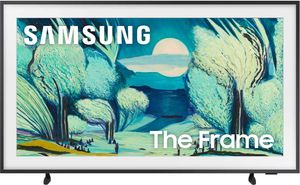
Narrow walls are where oversized screens ruin the art effect, and this 50 inch set exists for exactly those spots. Think bedroom above a dresser, a home office wall, or the stretch between a window and a bookcase where 55 inches would crowd the trim. The smaller panel keeps the proportions right so the bezel reads like a picture frame instead of a billboard. Art Mode, the matte finish, and the brightness sensor all work the same way here, which matters most in a bedroom where a glowing screen is unwelcome.
Top Features
• 50 inch screen size: Fits bedrooms, offices, and narrow walls where the art proportion has to read correctly.
• Art Mode with Vision AI: Runs artwork and photos at low brightness tuned to the room.
• Matte anti-glare screen: Keeps daylight and lamp reflections off the panel in smaller, brighter rooms.
• Customizable bezel support: Magnetic frames let the set match bedroom or office furniture finishes.
Samsung The Frame Pro LS03HW 85” Black 4K Neo QLED Vision AI Smart TV

This is the great room answer, and the size where the Pro tier matters most. Neo QLED backlighting pushes real brightness through the matte layer, which is what the earlier picture quality section identified as the standard tier’s weak point. At 85 inches the panel becomes the architecture of the room, so Art Mode is doing serious work during the hours nothing is playing. Plan on professional mounting here, since panel weight, precise centering, and hidden cable routing all get harder at this scale.
Top Features
• 85 inch Frame Pro panel: The statement size for great rooms and long open-concept sightlines.
• Neo QLED backlight: Mini-LED backlighting narrows the brightness and contrast gap with conventional sets.
• Vision AI picture handling: Later-generation processing on the top tier of the line.
• Art Mode at scale: Turns the largest wall in the house into artwork instead of black glass.
• Flush mount and hidden cable design: Built for a gallery-clean wall with nothing visible running down it.
Samsung The Frame Pro 85” 4K Ultra HD Neo QLED Art Mode Vision AI Smart TV

The second 85 inch Frame Pro covers the same statement wall from a different point in the release cycle, with Art Mode called out directly in its model naming. Everything that makes the Pro tier worth the step up is here, including Neo QLED backlighting for bright great rooms and the same low-profile mounting story. Because the two 85 inch models differ by generation rather than size, the smart move is comparing both product pages or calling our team to confirm which features and which model year you are buying.
Top Features
• 85 inch Neo QLED panel: Great room scale with mini-LED backlighting behind the matte finish.
• Art Mode gallery display: Included artwork, subscription library access, and personal photo uploads.
• Vision AI smart platform: Streaming apps and picture processing built into the set.
• Bright-room performance: Holds up in open floor plans with multiple windows and light sources.
Every set above can be delivered, mounted, wired with concealed in-wall cable, and configured in Art Mode by our installation team, so the first time you see it on your wall it already looks the way it does in the showroom.
A Frame TV Turns a Blank Wall Into Something Worth Looking At
A Frame TV works by combining a matte anti-glare screen, motion and light sensors, an Art Mode software layer, and single-cable routing that allows a truly flush mount. The trade is straightforward: you give up a measure of contrast and peak brightness compared with a conventional set at the same price, and you get back a wall that looks finished every hour the television is off.
Ready to see one in person? Shop Frame TV options at Flanner’s Home Entertainment & Appliance online or in our showrooms, where you can compare matte and glossy panels side by side in West Allis and Grafton and hold real bezel finishes against real furniture. Our pro-certified installers handle in-wall cable concealment, load-rated mounting, and Art Mode setup, and our service department is local when you need it years from now. That is what buying from a neighbor gets you instead of a warehouse.
Give us a call or book an in-home consultation, and we will measure the wall with you before anything gets ordered.
Frequently Asked Questions about Frame TVs
A Frame TV is a 4K television built to look like framed wall art, using a matte anti-glare screen, a swappable bezel, a flush mount, and an Art Mode that displays artwork when the set is idle. A regular TV is a glossy black panel that only looks good while it is turned on, which is the difference people notice most on a focal wall.
No, Art Mode draws far less power than full-brightness video because the panel runs dim and matches room lighting instead of pushing peak output. The motion sensor also powers the screen down when the room empties, and timers keep it from running overnight.
No, every Frame TV includes complimentary artwork and free rotating collections plus unlimited use of your own photos, so Art Mode works fully out of the box. The paid art library is optional and adds thousands of licensed museum and gallery pieces for people who want a deeper rotation.
A Frame TV delivers strong 4K picture quality, though a conventional set at the same price usually reaches deeper black levels and higher peak brightness. The matte screen trades a little contrast punch for much better glare control, and the Frame Pro tier narrows that gap with Neo QLED backlighting.
Yes, you can upload personal photos from a phone app or a USB drive and mix them into the Art Mode rotation. High-resolution horizontal images look best, and the mat layout and mat color options make a phone photo read like a framed print.
Yes, a Frame TV uses a slim flush mount that holds the panel nearly tight to the wall with no visible gap, which is part of what creates the framed-art look. Cables can be hidden completely by running in-wall rated low-voltage cable to a recessed enclosure for the One Connect box, which is standard practice on a professional installation.
Why Trust Flanners Home Entertainment?
When you choose Flanner’s Home Entertainment, you're trusting a deeply rooted, family-owned legacy that dates back to 1891 a company that has evolved from a piano and sheet-music shop into a premier specialty retailer of high-end audio, video, and smart-home systems. With showrooms in West Allis and Northshore Grafton, Flanner’s combines decades of expertise and personalized service. Its team includes members with 15–30 years of industry experience to design and install tailored home theater, multi-room audio, networking, and control solutions. Over its more than 130-year history, the business has maintained its commitment to craftsmanship, reliability, and genuine customer relationships, making every system feel as thoughtfully built as the business itself.